You paid for 20 leads last month. Half never picked up the phone. You booked two jobs.
Here's the part that stings more: the homeowner who did answer was also talking to three other contractors. The cheapest quote won. Not the best one the cheapest.
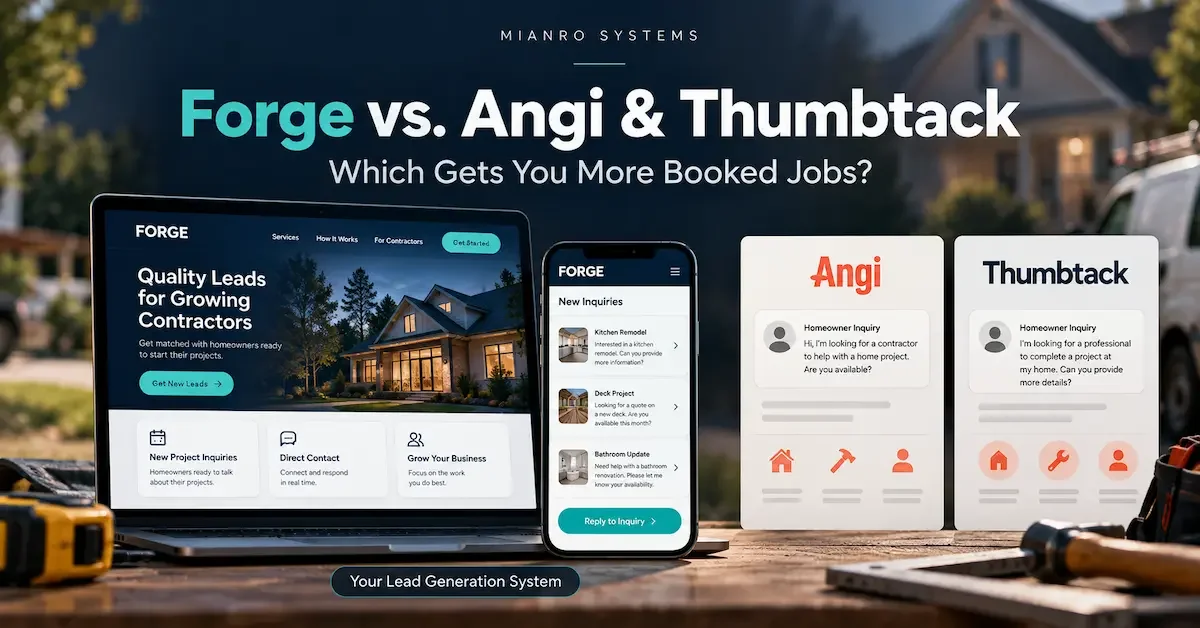
That's the real question behind lead generation website vs Angi / Thumbtack. Angi and Thumbtack rent you demand. Every lead you buy gets shared with 3–8 other contractors, and you're bidding against them on price. A lead generation website works differently it's yours. The calls come straight to you, with no one else on the other line.
The fair way to compare them isn't cost per lead. It's cost per booked job.
In this guide, you'll see real 2026 pricing, the math behind both options, when the platforms still make sense, and a 90-day plan to add a website without losing your calendar.
How Angi and Thumbtack Actually Charge You
Angi Leads membership plus pay-per-lead
Angi charges two ways. First, an annual membership, commonly around $300 a year, just to be in the program. Second, a fee for every lead sent your way typically $15 to $85. Roofing and other high-ticket trades can see leads priced over $100.
Here's the catch. You're charged when the lead arrives. Not when you win the job.
Thumbtack pay when a customer contacts you
Thumbtack skips the membership fee. No subscription, no yearly bill.
Instead, you pay per lead, and prices run roughly $8 to $150 depending on the trade. Most home service jobs land in the $25–$75 range.
You're charged the moment a customer messages you or requests a quote. Even if that customer never answers your call back.
Shared leads why you're racing other contractors
Here's the part that changes everything. A standard lead on either platform usually goes to 3 to 8 contractors at the same time. Roofing leads can be shared even wider.
So it's not just a sales call. It's a race.
Whoever calls first and
quotes lowest usually wins the job. You paid full price for
a lead, and most of the time, someone else drives away with the work.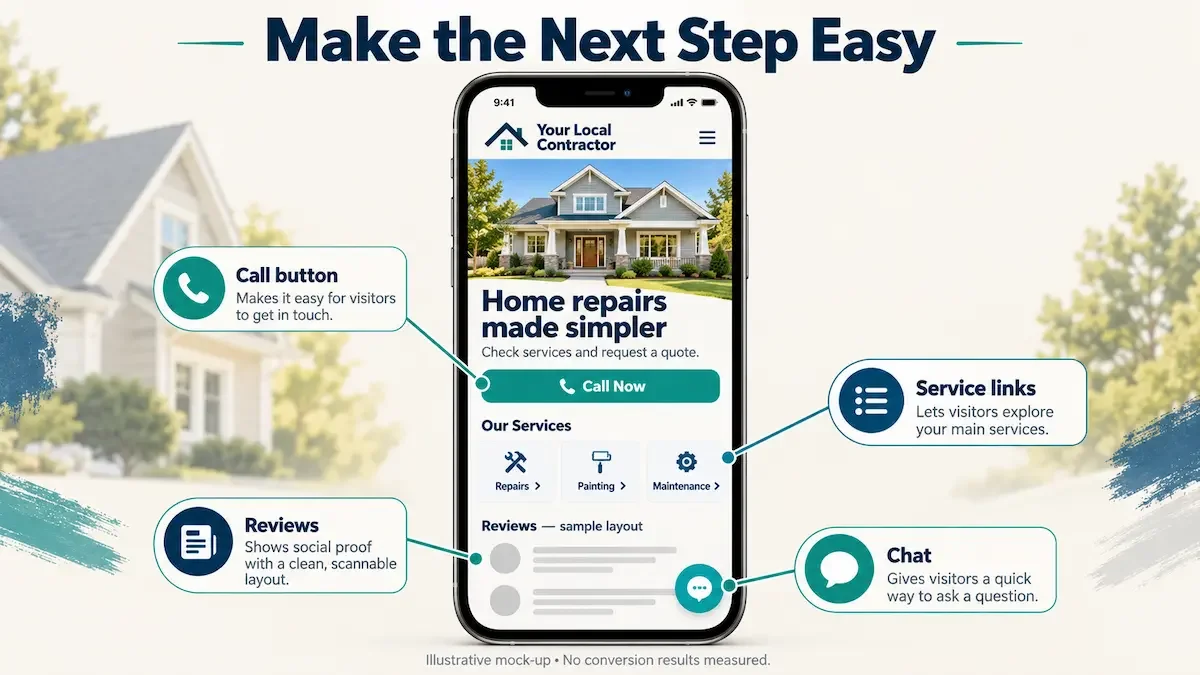
|
What you're told |
What's actually happening |
|
"You bought a lead" |
3–8 contractors bought the same lead |
|
"Cost per lead: $50" |
Cost per booked job: often $250+ |
|
"Fast response wins" |
Fast and cheapest response wins |
Both platforms can work. But the
number on the invoice is never the number that matters. That's next.
What a Lead Generation Website Is (and Why It’s Not Just a "Nice Website")
Before: Right now, every lead you pay for gets shared. You're racing other contractors to the phone, and the lowest quote usually wins.
After: Imagine a lead that's yours the second it lands. Nobody else got it. Nobody's racing you to the phone. The homeowner found you, not a list of five contractors who look the same.
Bridge: That's what a lead generation website system does.
Quick note on the name Google itself sometimes calls Angi and Thumbtack "lead generation websites." Confusing. In this guide, it means something different: a website you own, built to make the phone ring.
Exclusive leads from search, Google and ads
Visitors land on your site from Google search, your Google Business Profile, Maps, or your own ads. More of them now also arrive from AI answers, which our guide to AI search visibility explains. They searched for a contractor, found you, and clicked. That lead is yours. Nobody bought it alongside you.
The parts that make it convert
A website that gets calls isn't about looking good. It's built with a few specific pieces:
• Phone number and click-to-call button above the fold on mobile
• One page per service, and one page per service area (see our Elevate local SEO service)
• A short quote form, plus AI chat for visitors who won't pick up the phone
• Reviews and trust badges placed near every call-to-action
• Fast mobile load time slow sites lose calls before they happen
• Every form and chat message routed straight into a CRM, with instant follow-up
Here's a simple way to check your own site: if your About page gets more traffic than your service pages, you don't have a design problem. You have a structure problem.
Side-by-Side: Your Website vs. Angi vs. Thumbtack
|
Factor |
Your lead generation website |
Angi |
Thumbtack |
|
How you pay |
Build + monthly running cost |
Annual fee + per lead |
Per contact, no subscription |
|
Who else gets the lead |
Nobody |
Often several pros |
Often several pros |
|
Who owns the reviews |
You (Google) |
Angi |
Thumbtack |
|
Speed to first leads |
Slower (weeks–months for SEO; faster with ads) |
Fast |
Fast |
|
What's left when you stop paying |
Rankings, reviews, customer list |
Nothing |
Nothing |
|
Controls the first impression |
You |
Platform profile |
Platform profile |
No surprise where each one wins.
Angi and Thumbtack get you leads fast that's the whole pitch. A website takes longer
to ramp up, but you own what it builds: rankings, reviews, a customer list.
Stop paying Angi tomorrow and your pipeline goes quiet overnight. Stop paying
for your website's hosting and your rankings don't vanish with it.
The Real Math Cost per Booked Job, Not Cost per Lead
The formula
Cost per booked job = cost per lead ÷ close rate.
Cost per lead is what the invoice says. Cost per booked job is what the business pays.
Worked example
|
Lead price |
Close rate |
Cost per booked job |
|
$50 |
20% |
$250 |
|
$50 |
10% |
$500 |
|
$50 |
6% |
$833 |
Source: Profit Acuity analysis via WBOC.
Look at that table again. The lead price never moved it stayed at $50 the whole time. Only the close rate changed. That's the number that decides whether a lead was cheap or expensive.
Here's the part that surprises most owners: an exclusive lead can cost more on paper and still be cheaper per job. A $90 lead that nobody else got, with a 35% close rate, runs about $257 per booked job. Cheaper than a $50 shared lead closing at 6% and you didn't lose three bids to get there.
Hidden costs nobody puts on the invoice
The invoice is never the full bill. Add in:
• Time spent calling leads who never pick up
• Gas and drive time to estimates that don't book
• Hours disputing fake or out-of-area leads with the platform
• Discounts you gave just to beat someone else's quote on the same job
None of that shows up on the monthly statement. All of it comes out of your margin.
Track every lead source for 90 days in one sheet leads, booked jobs, revenue. The answer is usually obvious by week six.
When Angi or Thumbtack Still Makes Sense
Platforms aren't the enemy here. They're the wrong tool for some jobs and the right one for others.
They make sense when:
• You're a brand-new business with no reviews and no website yet
• You need to fill gaps in a slow season
• You're chasing small, quick, high-volume jobs where speed beats margin
• You can answer every lead within minutes, every time, without exception
If any of those describe you, keep your platform account. Just don't build your whole business on it.
The rule of thumb: treat Angi and Thumbtack as one channel, not the business. A channel you can turn on and off. Not the only thing keeping your calendar full.
The Asset Gap: What You Own After 12 Months
Before: Twelve months of platform spend. Call it $2,000 to $4,000 a month between fees and leads. Then one month you stop paying. The leads stop that same day. Your reviews? Still sitting on Angi's platform, not yours.
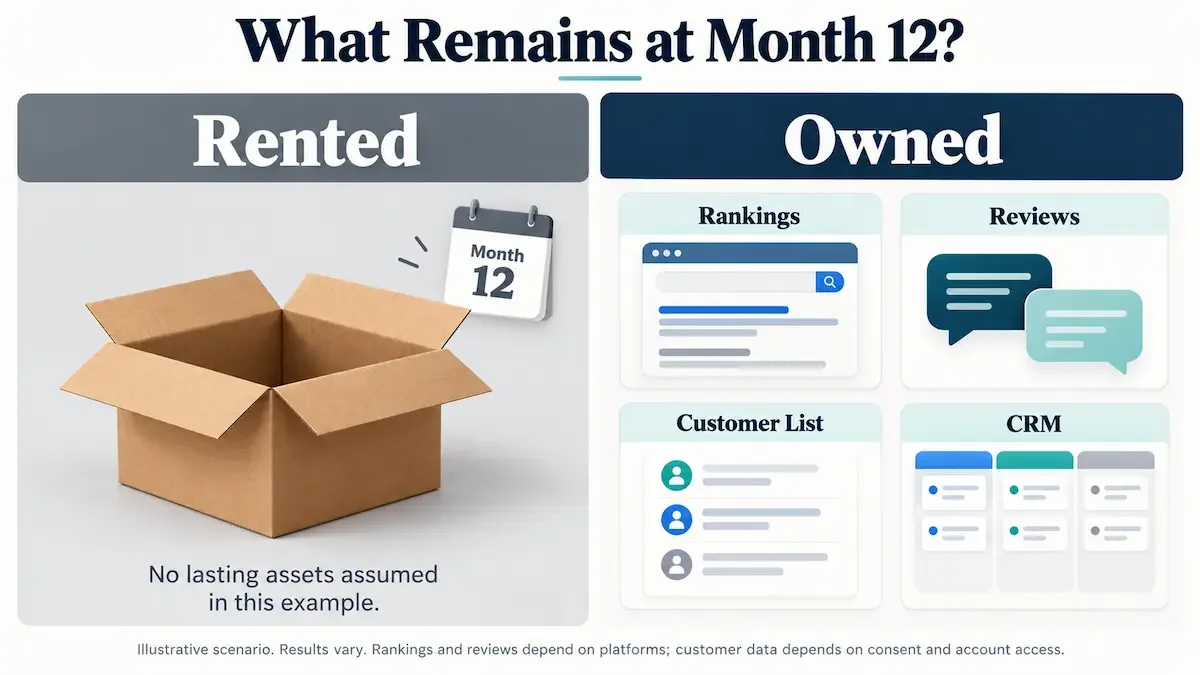
After: Twelve months of a lead generation website. Stop paying for ads tomorrow, and here's what stays: your Google rankings. Your Google reviews. A list of past customers you can re-market to. A CRM full of follow-up history on every lead you ever got.
Bridge: One of these is rent. The other is an asset.
|
Rented (Angi/Thumbtack) |
Owned (Your Website) |
|
Stop paying → leads stop same day |
Stop paying ads → rankings stay |
|
Reviews live on their platform |
Reviews live on your Google profile |
|
No customer list to re-market to |
Full customer list, ready to re-market |
|
Nothing carries forward |
CRM history, rankings, reviews all carry forward |
Same dollars spent. Very
different thing left standing at month 12.
Speed-to-Lead: The Hidden Leak in Both Channels
Shared leads go to whoever reaches the homeowner first. That much you know.
Here's what most contractors miss: your own website leads die the same way if nobody answers.
Industry research puts after-hours inquiries at more than 40% of total call volume for local service businesses and higher for emergency trades like plumbing and HVAC Most of those calls hit voicemail. Most callers don't leave a message. They just call the next name on the list. Our guide on how to reduce lost revenue from missed business calls shows how to audit unanswered inquiries and fix the gaps.
So owning your leads doesn't automatically mean you keep them. It just means you've earned the right to lose them a different way by not answering.
The fix is instant replies, everywhere a lead can arrive:
• AI chat answering questions on your site, any hour
• A text sent automatically the moment you miss a call
• Auto-SMS to anyone who fills out your quote form
• A CRM task that puts the lead in front of your team within minutes
Owning your website fixes who gets the lead. Speed fixes whether you keep it. Our AI automation playbook for home service businesses shows how trades can stop losing jobs to missed calls.
Try this tonight: fill in your own site's form at 9 pm. Time how long it takes to hear back. That number is your speed-to-lead score and it's costing you jobs either way.
Form submitted → instant SMS
→ CRM task created → call within 5 minutes. That's the standard to build
toward.
A 90-Day Plan to Move Off Rented Leads Without an Empty Calendar
You don't cancel Angi on day one. You build the alternative first, then shift the budget once it's proven.
Days 1–30 Build while platforms keep running
• Launch a conversion-built website: service pages, service-area pages, click-to-call, a short form, AI chat
• Claim and fully complete your Google Business Profile; ask recent customers for Google reviews
• Connect every form, call, and chat into one CRM no leads living in separate inboxes
Days 31–60 Measure every channel the same way
• Track leads, booked jobs, revenue, and cost per booked job for your website, Angi, and Thumbtack in one shared sheet
• Turn on instant reply and missed-call text-back across every channel
Days 61–90 Move budget to what wins
• Cut the weakest-performing platform budget first; keep any channel that's still profitable
• Move the saved spend into local ads or more service pages on your own site
Don't switch off a platform until your own site has booked jobs for 30 days straight. The goal isn't an empty calendar while you wait and see.
How Forge Turns Your Website Into a Lead System
Before: A website that looks fine, sitting next to paid platform leads you share with three to eight other contractors. The site exists. It just doesn't do much.
After: A website built around calls, forms, and AI chat connected straight into your CRM, so every lead gets followed up the same way, every time.
The Forge flow: A lead enters → Forge captures it → your team sees it instantly → follow-up continues automatically until it's booked or closed.
Here's what that looks like by trade. An HVAC contractor's site rebuilt around click-to-call and clear emergency paths, so a 2 am no-heat call doesn't sit in a form queue. An appliance repair business with pages organized by appliance, brand, and service area, so Google sends the right searcher to the right page. A landscaping company with estimate forms split by project type, so a mulch job and a full redesign don't get the same generic quote request.
These are scenarios, not promised results every business converts differently.
That's a conversion-focused contractor website, purpose-built for HVAC, appliance repair, landscaping, and similar trades.
See how Forge would work for
your business →
Frequently Asked Questions
Is Angi worth it for contractors in 2026?
It can be, especially for new businesses that reply within minutes. Don't judge it by the lead price judge it by cost per booked job, which accounts for how many contractors shared each lead.
How much does Thumbtack charge per lead?
Roughly $8 to $150 depending on the trade, with most home service jobs falling between $25 and $75. You're charged when a customer contacts you, not when the job books.
Are Angi and Thumbtack leads shared?
Often, yes. The same homeowner request commonly goes out to 3 to 8 contractors at once, and whoever responds first and quotes lowest usually wins the job.
Which books more jobs: my own website or the platforms?
Your own site usually converts better per lead, since nobody else gets it. Platforms win early on, because they deliver volume faster than SEO can build it.
How do I calculate cost per booked job?
Total spend on a lead source, divided by the number of jobs you booked from it. That single number tells you more than cost per lead ever will.
How long until a lead generation website brings leads?
Paid ads can bring calls within days. Organic search traffic (SEO) typically takes months to build. It varies by market and competition there's no fixed timeline to promise.
Do I lose my reviews if I leave Angi or Thumbtack?
Yes, those reviews stay on the platform's profile, not yours. Start collecting Google reviews now, so you're building an asset you keep regardless of what platforms you use later.
Should I stop using Angi completely?
Not overnight. Build your website first, measure both channels side by side, then shift budget gradually the 90-day plan above walks through exactly how.
What does a website need to get calls?
Click-to-call above the fold, dedicated service pages, visible reviews, fast mobile load time, and instant follow-up on every form or chat message.
Is Google Local Services Ads better than Angi?
LSA leads are exclusive to you, unlike Angi's shared model. Compare both using cost per booked job, since LSA's higher lead price often still works out cheaper per job.
Conclusion
Angi and Thumbtack rent you demand. A lead generation website lets you own it. And speed on both decides whether you actually keep the lead you paid for or got for free.
You don't need to pick one and walk away from the other tomorrow. Run the 90-day test. Build the website, track both channels the same way, then move your budget toward whatever's actually winning.